One-carbon metabolism is a core metabolic network that transfers single-carbon units through the folate cycle, methionine cycle, and transsulfuration pathway. By linking nutrient status to nucleotide synthesis, methylation capacity, and redox balance, the one-carbon metabolism pathway is highly relevant to cancer, immune regulation, aging, neurodevelopment, and cardiometabolic disease. This article explains the pathway logic, key one-carbon donors and biomarkers, disease-related research examples, and practical strategies for measuring one-carbon metabolism using one-carbon targeted metabolomics and multi-omics integration.
1. ONE-CARBON METABOLISM BASICS: DEFINITION, PATHWAYS, DONORS, AND BIOLOGICAL ROLES
1.1 What Is One-Carbon Metabolism and Why Does It Matter?
In practical terms, one-carbon metabolism determines how cells capture and use small carbon units from nutrients. These carbon units are transferred through the folate and methionine cycles to support three major biological needs: building nucleotides, maintaining methylation potential, and protecting cells from oxidative stress. This is why the pathway becomes especially important in systems with high biosynthetic demand, such as tumor growth, immune cell activation, embryonic development, and tissue remodeling. For researchers, one-carbon metabolism is valuable because many of its key nodes can be measured directly by targeted metabolomics, including folate species, serine, glycine, methionine, SAM, SAH, homocysteine, and glutathione.
1.2 Core One-Carbon Metabolism Pathway: Folate Cycle, Methionine Cycle, and Transsulfuration
The folate cycle carries one-carbon units in different chemical forms and supports purine and thymidylate synthesis. The methionine cycle converts methionine into S-adenosylmethionine (SAM), the major methyl donor for cellular methylation reactions, and then to S-adenosylhomocysteine (SAH) and homocysteine. Homocysteine can either be remethylated to methionine or enter transsulfuration to support cysteine and glutathione production. Together, these pathways link biosynthesis, methylation capacity, and oxidative stress control.
1.3 One-Carbon Donors: Serine, Glycine, Choline, and Formate
The major one-carbon donors include serine, glycine, choline, betaine, and formate. Serine and glycine feed the folate cycle through SHMT-dependent reactions and are central to the serine-glycine-one-carbon metabolism network. Choline contributes through betaine-dependent homocysteine remethylation, while formate can act as a mobile one-carbon source generated from mitochondrial folate metabolism. These donors help determine how much one-carbon flux is available for nucleotide synthesis, methylation, and redox balance.
1.4 Biological Roles of One-Carbon Metabolism in Research
For biomedical research, the most important outputs of one-carbon metabolism are nucleotide synthesis, SAM/SAH-dependent methylation potential, and glutathione-linked redox regulation. These functions explain why one-carbon metabolism is frequently studied in cancer biology, immunometabolism, aging, neurodevelopment, cardiometabolic disease, and nutritional intervention studies. Key measurable biomarkers include folate species, serine, glycine, methionine, SAM, SAH, homocysteine, choline, betaine, cystathionine, and glutathione.
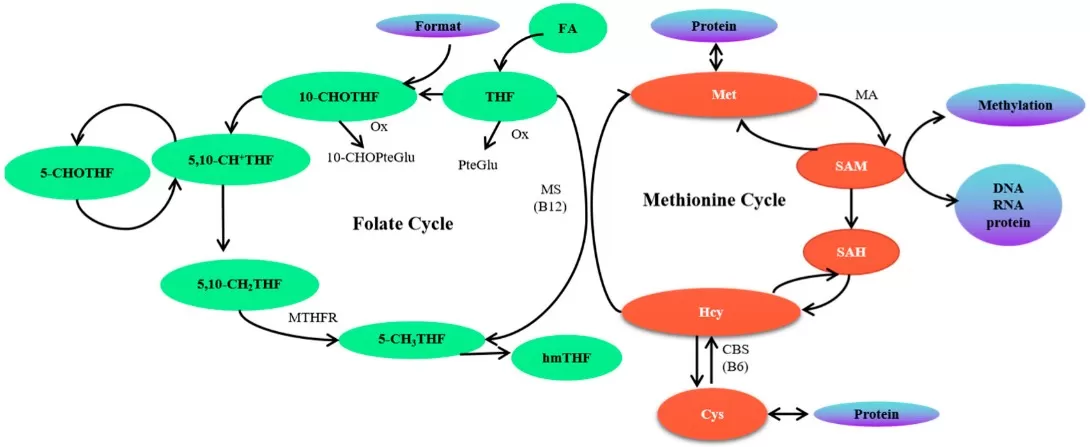
Figure 1. Overview of the folate one-carbon metabolism pathway, including the folate cycle, methionine cycle, and transsulfuration. Image adapted from Ling et al., 2024, International Journal of Molecular Sciences, under the CC BY 4.0 license.
2. ONE-CARBON METABOLISM IN CANCER AND IMMUNE FUNCTION
2.1 One-Carbon Metabolism in Cancer: SGOC Rewiring, Biomarkers, and Therapeutic Vulnerabilities
Cancer cells often increase serine-glycine-one-carbon (SGOC) metabolism to support nucleotide synthesis, redox balance, and methylation-dependent plasticity. Recent studies highlight MTHFD2, SHMT2, and MTHFD1 as important one-carbon metabolism nodes in tumor growth, immune evasion, and therapy response. For example, recent studies highlight enzymes such as SHMT2, MTHFD1, and MTHFD2 as important one-carbon metabolism nodes in tumor growth, nucleotide synthesis, redox adaptation, and therapy response. Depending on tumor type and genetic context, altered folate flux may also interact with immune signaling and tumor microenvironment remodeling. These findings make one-carbon metabolomics especially useful for studying cancer proliferation, metabolic vulnerability, and drug response.
2.2 One-Carbon Metabolism in Immune Cells and Inflammation
Activated immune cells also rely on one-carbon metabolism. In T cells, methionine metabolism, SAM/SAH balance, and MTHFD2-dependent purine synthesis can influence proliferation, cytokine production, differentiation, and exhaustion. This is particularly relevant in tumor immunology, where nutrient competition in the tumor microenvironment may reshape T cell function. For immunometabolism studies, methionine, SAM, SAH, homocysteine, serine, glycine, and glutathione are key biomarkers that can connect metabolic status with immune phenotype.
2.3 Recommended One-Carbon Metabolism Biomarkers by Application
| Research Application | Priority One-Carbon Biomarkers | Notes |
|---|---|---|
| Cancer metabolism | Folate species, serine, glycine, methionine, SAM, SAH, homocysteine, cystathionine, glutathione | SGOC rewiring, nucleotide synthesis, redox balance |
| Immunometabolism | Methionine, SAM, SAH, homocysteine, serine, glycine, glutathione | T cell activation, cytokine production, exhaustion |
| Aging & longevity | Folate cycle metabolites, methionine cycle markers, SAM/SAH ratio | Combine with phenotype and transcriptome data |
| Neurodevelopment & neurological disease | Folate species, homocysteine, SAM, SAH, vitamin B12/B6 cofactors | Integrate with broader pathway and clinical markers |
| Cardiometabolic disease | Homocysteine, folate status, SAM/SAH balance, cystathionine | Homocysteine alone is insufficient; use full panel |
| Nutritional intervention | Folate, vitamin B12, B6, choline, betaine, methionine, serine | Covariates for study design and interpretation |
3. ONE-CARBON METABOLISM IN AGING, NEURODEVELOPMENT, CARDIOMETABOLIC DISEASE, AND NUTRITIONAL GENETICS
Beyond cancer and immunity, one-carbon metabolism is also relevant to aging, neurodevelopment, cardiometabolic disease, and nutritional intervention. In aging research, folate-cycle remodeling and methionine-cycle changes have been linked to longevity-associated metabolic states. In cardiovascular and neurological studies, homocysteine remains a widely used biomarker, although it should be interpreted together with folate status, SAM/SAH balance, and broader pathway biomarkers rather than as a standalone marker.
Developmental biology provides one of the clearest examples of one-carbon metabolism in human health: folate-dependent metabolism supports nucleotide synthesis and methylation during early growth. Nutritional and genetic factors, including folate, vitamin B12, vitamin B6, choline, betaine, methionine, and folate-pathway variants, are important covariates when designing one-carbon metabolomics studies.
4. HOW TO MEASURE ONE-CARBON METABOLISM WITH LC–MS/MS AND MULTI-OMICS
4.1 Targeted One-Carbon Metabolomics by LC–MS/MS
For most hypothesis-driven studies, targeted LC–MS/MS is the most practical and informative assay layer. Recent validated methods quantify panels ranging from focused methionine-cycle biomarkers to broader one-carbon sets that include folate species, serine, glycine, methionine, homocysteine, SAM, SAH, cystathionine, choline, betaine, B vitamins, and related cofactors. In human plasma, a 2022 UPLC–MS/MS method quantified 22 one-carbon metabolites and cofactors in just 100 µL of sample, while 2024 studies expanded simultaneous coverage of folate forms and methionine-cycle metabolites across plasma, serum, whole blood, and other biological materials. Published LC–MS/MS methods have also demonstrated sensitive quantification of SAM and SAH in small-volume plasma samples.
The main analytical challenge is not instrument sensitivity alone but metabolite instability. Reduced folates are especially labile and can interconvert during extraction and acidic chromatography. Therefore, rapid cold processing, light protection, minimized freeze-thaw exposure, appropriate internal standards, pooled QC, blanks, and batch-aware acquisition planning are important for reliable one-carbon metabolomics.
4.2 Targeted One-Carbon Metabolite Panel
| Metabolite | Pathway | Key Role |
|---|---|---|
| 5-Methyltetrahydrofolate (5-MTHF) | Folate cycle | Major circulating folate form; homocysteine remethylation |
| Tetrahydrofolate (THF) | Folate cycle | Central one-carbon carrier; precursor pool for folate-dependent biosynthesis |
| 5,10-Methylenetetrahydrofolate | Folate cycle | Thymidylate synthesis; folate-mediated one-carbon transfer |
| S-Adenosylmethionine (SAM) | Methionine cycle | Universal methyl donor for DNA/RNA/protein methylation |
| S-Adenosylhomocysteine (SAH) | Methionine cycle | Methyltransferase inhibitor; SAM/SAH ratio indicator |
| Methionine | Methionine cycle | Essential amino acid; SAM precursor |
| Homocysteine | Methionine cycle / Transsulfuration | Branch point between remethylation and transsulfuration; cardiovascular research marker |
| Cystathionine | Transsulfuration | Intermediate between homocysteine and cysteine |
| Cysteine | Transsulfuration | Glutathione precursor; redox defense |
| Glutathione (GSH) | Transsulfuration | Major cellular antioxidant; redox balance |
| Serine | Folate cycle input | Major one-carbon donor via SHMT; serine synthesis pathway |
| Glycine | Folate cycle input | One-carbon donor; purine synthesis; glutathione synthesis |
| Choline | Methionine cycle input | Betaine precursor for homocysteine remethylation |
| Betaine | Methionine cycle input | Methyl donor via BHMT; homocysteine remethylation |
If your project needs robust one-carbon biomarkers rather than general polar metabolomics alone, MetwareBio offers a one-carbon metabolism targeted panel covering 28 key metabolites across the folate and methionine cycles, with absolute quantification supported by internal and external standards, ng/mL-level sensitivity, and standardized QC. Supported matrices include plasma, serum, CSF, tissues, cultured cells, organelles, and other biofluids, and the same projects can be extended into transcriptomics, proteomics, or integrated multi-omics for mechanism-focused interpretation.
4.3 Integrating One-Carbon Metabolomics with Transcriptomics, Proteomics, and Public GEO Data
Targeted one-carbon metabolomics becomes more informative when metabolite changes are interpreted together with gene expression, protein abundance, and pathway-level context. Changes in SAM/SAH ratio, folate species, serine, glycine, or homocysteine can be compared with key one-carbon metabolism genes, including PHGDH, PSAT1, SHMT1, SHMT2, MTHFD1, MTHFD2, MTHFR, TYMS, DHFR, MAT2A, AHCY, BHMT, CBS, and CTH. This helps determine whether the observed phenotype is linked to altered substrate availability, enzyme regulation, methyl-donor balance, or compensatory pathway rewiring.
Public GEO datasets can support hypothesis generation before targeted validation. Researchers can examine whether one-carbon metabolism genes are consistently altered in specific disease models, treatment groups, or patient cohorts, then use LC–MS/MS-based metabolite profiling to validate pathway-level changes in their own samples. This strategy is especially useful in cancer metabolism, immunometabolism, aging, neurological disease, and nutrition-related studies.
5. EXPERIMENTAL DESIGN TIPS FOR ONE-CARBON METABOLISM STUDIES
5.1 Sample Collection and Pre-Analytics for One-Carbon Metabolomics
Reliable one-carbon metabolomics depends on both analytical performance and experimental design. Because folate derivatives, SAM/SAH, and related sulfur-containing metabolites can be chemically labile, poorly controlled sample handling may create artifacts before LC–MS/MS analysis begins. For plasma and serum, collection-to-freezing time should be short, samples should be processed cold, hemolysis should be minimized, and repeated freeze-thaw cycles should be avoided. For tissues and cultured cells, rapid quenching, consistent extraction conditions, and predefined normalization methods are essential for comparing one-carbon metabolite levels across groups.
5.2 Quality Control and Nutrient Conditions in LC–MS/MS Studies
Quality control is equally important. Targeted LC–MS/MS studies should include blanks, calibration standards, internal standards, pooled QC samples, randomized run order, and clear acceptance criteria for data review. In animal and cell-based studies, diet and medium composition also need attention because folate, vitamin B12, methionine, serine, glycine, and choline levels can strongly influence the one-carbon metabolism pathway. Without these controls, differences between groups may reflect nutrient conditions rather than the biological variable being tested.
5.3 Choosing One-Carbon Metabolism Biomarkers by Research Question
Readout selection should start from the research question. Cancer studies may prioritize folate species, serine/glycine balance, methionine-cycle metabolites, nucleotide-related phenotypes, and drug response. Immunometabolism studies often require methionine, SAM, SAH, homocysteine, and functional markers such as cytokine production or T cell exhaustion. Aging, neurological, and cardiometabolic studies may benefit from combining one-carbon metabolite profiling with transcriptomic, proteomic, or phenotype-level data rather than relying on homocysteine alone.
5.4 From Study Design to Data Interpretation with MetwareBio
For researchers planning one-carbon metabolism studies, MetwareBio can support the full workflow from experimental design consultation to targeted LC–MS/MS detection, data quality control, pathway interpretation, and integrated multi-omics analysis. Contact MetwareBio to discuss a customized one-carbon metabolism study design.
6. FAQ ON ONE-CARBON METABOLISM FOR RESEARCHERS
6.1 What is the difference between one-carbon metabolism and central carbon metabolism?
Central carbon metabolism includes glycolysis, the TCA cycle, and the pentose phosphate pathway, which mainly supply energy and carbon skeletons. One-carbon metabolism is a more specialized network that transfers single-carbon units for nucleotide synthesis, methylation reactions, and redox balance. The two systems are connected through serine synthesis, mitochondrial metabolism, and NAD(P)H production.
6.2 How do I choose between plasma and tissue samples for one-carbon metabolomics?
Plasma or serum is useful for biomarker discovery, nutritional status assessment, and translational studies. Tissue or cell samples are better for mechanism-focused research because they reflect local pathway activity more directly. For questions involving folate species, SAM/SAH balance, or compartment-specific metabolism, tissue or cell extracts often provide more interpretable data.
6.3 Which one-carbon metabolites are most informative in cancer, immune, and aging studies?
Cancer studies often focus on folate species, serine, glycine, methionine, SAM, SAH, homocysteine, cystathionine, and glutathione. Immunometabolism studies usually require methionine, SAM, SAH, and homocysteine. Aging and neurological studies benefit from combining folate-cycle metabolites with methionine-cycle markers and phenotype-level data.
6.4 How do folate, vitamin B12, and vitamin B6 deficiencies show up in one-carbon metabolite profiles?
Folate or vitamin B12 deficiency often leads to impaired homocysteine remethylation, lower methyl-donor capacity, and elevated homocysteine. Vitamin B6 deficiency more strongly affects transsulfuration, which can alter cystathionine, cysteine, and glutathione-related biomarkers. Exact metabolite patterns depend on sample type, diet, genotype, and disease context.
6.5 What is the SAM/SAH ratio and how should I interpret it?
The SAM/SAH ratio is commonly used as an indicator of methylation potential. SAM provides methyl groups for DNA, RNA, protein, and lipid methylation, while SAH can inhibit methyltransferases when it accumulates. A lower SAM/SAH ratio may suggest reduced methylation capacity, but it should be interpreted together with methionine, homocysteine, and folate status.
6.6 How does one-carbon metabolism interact with glycolysis and the TCA cycle?
One-carbon metabolism is connected to glycolysis through serine biosynthesis, because serine can be produced from glycolytic intermediates and then used as a major one-carbon donor. It also connects to mitochondrial metabolism through formate production, NAD(P)H balance, and biosynthetic routing. These links help coordinate energy metabolism with nucleotide synthesis and methylation demand.
6.7 What are the most common pitfalls in one-carbon metabolism experiments?
Common pitfalls include unstable folate handling, inconsistent diet or cell culture medium composition, hemolysis, poor batch design, and overinterpreting homocysteine as a complete pathway marker. For stronger conclusions, targeted one-carbon metabolomics should be combined with appropriate functional biomarkers and, when possible, transcriptomic or proteomic evidence.
7. CONCLUSION: WHY ONE-CARBON METABOLISM BELONGS ON YOUR EXPERIMENTAL RADAR
One-carbon metabolism is a measurable link between nutrient status, nucleotide synthesis, methyl-donor balance, and redox defense, which explains its relevance to cancer metabolism, immune regulation, aging, neurodevelopment, and cardiometabolic disease. For researchers, the key is to move beyond pathway diagrams and quantify actionable biomarkers with targeted LC–MS/MS metabolomics. When combined with transcriptomic, proteomic, or public GEO-based evidence, one-carbon metabolite profiling can help clarify mechanisms and strengthen experimental conclusions.
Read More: Metabolomics, Methylation, and Related Pathways
Explore these related articles to deepen your understanding of one-carbon metabolism, amino acid biochemistry, methylation biology, and LC–MS/MS-based omics approaches.
Methionine is the direct precursor of SAM, the universal methyl donor in one-carbon metabolism. This article explains the methionine cycle in detail, covering SAM-dependent methylation, the SAM/SAH ratio as a methylation capacity indicator, and the connection to redox homeostasis through transsulfuration and glutathione synthesis.
One of the key downstream outputs of SAM-dependent one-carbon metabolism is protein methylation. This article covers the enzymes and substrates involved, how protein methylation regulates gene expression and signal transduction, and which analytical methods — including mass spectrometry-based approaches — are used to detect and quantify methylation marks.
Choosing the right metabolomics strategy is critical when designing one-carbon studies. This article compares targeted, untargeted, and widely-targeted metabolomics — covering coverage, sensitivity, quantification accuracy, and ideal use cases — to help researchers select the most appropriate approach for their experimental goals.
Glycine is one of the primary one-carbon donors in the folate cycle, contributing single-carbon units through the glycine cleavage system. This article reviews glycine's biochemical functions, its role in nucleotide synthesis and glutathione production, and how it is measured in metabolomics studies with relevance to serine-glycine-one-carbon metabolism research.
NAD+/NADH and NADP+/NADPH redox systems are functionally connected with mitochondrial metabolism, redox balance, and biosynthetic pathways related to one-carbon metabolism.
One-carbon metabolism does not operate in isolation — it is closely connected to glycolysis through serine biosynthesis and to mitochondrial metabolism through formate production. This article provides a clear overview of central carbon metabolism (glycolysis, TCA cycle, pentose phosphate pathway) and explains how these pathways interconnect with the folate and methionine cycles.
References
- Bernasocchi, T., & Mostoslavsky, R. (2024). Subcellular one carbon metabolism in cancer, aging and epigenetics. Frontiers in Epigenetics and Epigenomics, 2, 1451971. https://doi.org/10.3389/freae.2024.1451971
- Lee, Y., Vousden, K. H., & Hennequart, M. (2024). Cycling back to folate metabolism in cancer. Nature Cancer, 5, 701–715. https://doi.org/10.1038/s43018-024-00739-8
- Sugiura, A., et al. (2022). MTHFD2 is a metabolic checkpoint controlling effector and regulatory T cell fate and function. Immunity, 55(1), 65–81.e9. https://doi.org/10.1016/j.immuni.2021.10.011
- Sharma, P., et al. (2025). Early methionine availability attenuates T cell exhaustion. Nature Immunology, 26, 1384–1396. https://doi.org/10.1038/s41590-025-02223-6
- Ling, Y., et al. (2024). Simultaneous determination of one-carbon folate metabolites and one-carbon-related amino acids in biological samples using a UHPLC–MS/MS method. International Journal of Molecular Sciences, 25(6), 3458. https://doi.org/10.3390/ijms25063458
- Chen, P., et al. (2022). A sensitive UPLC-MS/MS method for simultaneous quantification of one-carbon metabolites & co-factors in human plasma. Journal of Pharmaceutical and Biomedical Analysis, 219, 114944. https://doi.org/10.1016/j.jpba.2022.114944
- Annibal, A., et al. (2021). Regulation of the one carbon folate cycle as a shared metabolic signature of longevity. Nature Communications, 12, 3486. https://doi.org/10.1038/s41467-021-23856-9
- Clough, E., et al. (2024). NCBI GEO: archive for gene expression and epigenomics data sets: 23-year update. Nucleic Acids Research, 52(D1), D138–D144. https://doi.org/10.1093/nar/gkad965
- Kirwan, J. A., et al. (2022). Quality assurance and quality control reporting in untargeted metabolic phenotyping: mQACC recommendations for analytical quality management. Metabolomics, 18, 70. https://doi.org/10.1007/s11306-022-01926-3