Plant Hormones
Plant Hormone Profiling: An Overview
Why Choose MetwareBio for Plant Hormone Analysis?
Plant Hormone Assay Coverage
MetwareBio’s plant hormone panel provides broad coverage of major phytohormone pathways, including active hormones, precursors, metabolites, and conjugated forms where applicable. By profiling multiple hormone classes within a unified targeted LC–MS/MS workflow, the assay enables researchers to compare coordinated hormone changes, investigate pathway-specific regulation, and explore hormone crosstalk across biological conditions. The table below summarizes the number of analytes, representative compounds, and key research relevance for each hormone class.
Coverage of MetwareBio’s Plant Hormone Targeted Metabolomics Panel
| Plant Hormone Class | No. of Targets | Representative Targets | Research Value |
| Auxins | 27 | IAA, ME-IAA, IBA, ICA, ICAld, IPA, IAA-Glc, IAA-Glu, IAN, and more | Support studies of cell elongation, root architecture, apical dominance, organ formation, and auxin transport or conjugation. |
| Cytokinins (CK) | 40 | IP, tZ, cZ, DZ, IPR, tZR, cZR, DHZ7G, DHZR, and more | Evaluate cell division, shoot initiation, senescence, nutrient signaling, and cytokinin homeostasis across active and conjugated forms. |
| Jasmonates (JA) | 11 | MEJA, JA, H2JA, JA-ILE, OPDA, JA-Phe, JA-Val, OPC-4, OPC-6, 12-OH-JA, JA-ACC | Characterize wound response, herbivore defense, pathogen response, reproductive development, and jasmonate signaling activation. |
| Salicylic Acid-Related Metabolites (SA) | 6 | SA, SAG, Phe, t-CA, 2-Coumarate, MeSAG | Support analysis of plant immunity, systemic acquired resistance, phenylpropanoid-linked signaling, and stress-related SA derivatives. |
| Abscisic Acid (ABA) | 3 | ABA, ABA-GE, ABA-ald | Assess drought response, stomatal regulation, seed dormancy, stress adaptation, and ABA storage or transport forms. |
| Gibberellins (GA) | 18 | GA1, GA15, GA19, GA20, GA24, GA3, GA4, GA53, GA7, and more | Investigate seed germination, stem elongation, flowering, fruit development, growth regulation, and GA biosynthesis or deactivation. |
| Ethylene Precursor (ACC) | 1 | ACC | Monitor ACC as a key ethylene precursor for fruit ripening, senescence, stress response, and ethylene-related signaling studies. |
| Strigolactones (SL) | 2 | ST, 5DS | Support studies of root architecture, shoot branching, rhizosphere signaling, mycorrhizal interaction, and strigolactone-related regulation. |
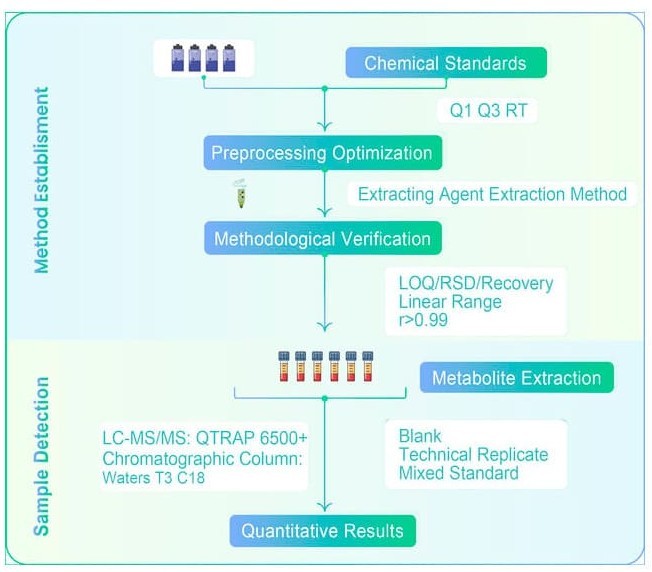
Project Workflow of LC–MS/MS Phytohormone Profiling
MetwareBio’s plant hormone targeted metabolomics service follows a standardized workflow from plant sample collection and low-temperature handling to phytohormone extraction, LC-MS/MS MRM detection, absolute quantification, quality control evaluation, and biological interpretation. Extracted phytohormones are detected using optimized MRM transitions and quantified using chemical standards with internal standard correction where applicable. The resulting data are processed through QC evaluation, statistical comparison, differential hormone analysis, and pathway-focused interpretation to support reliable plant hormone research.
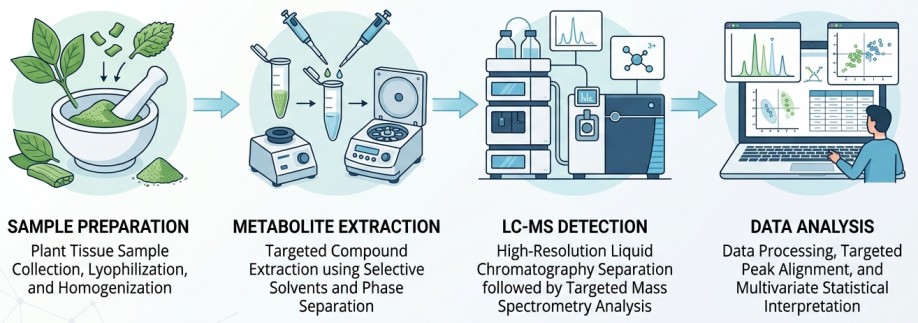
Step-by-Step Workflow of MetwareBio’s Plant Hormone Targeted Metabolomics: From Sample Treatment to Biological Insights
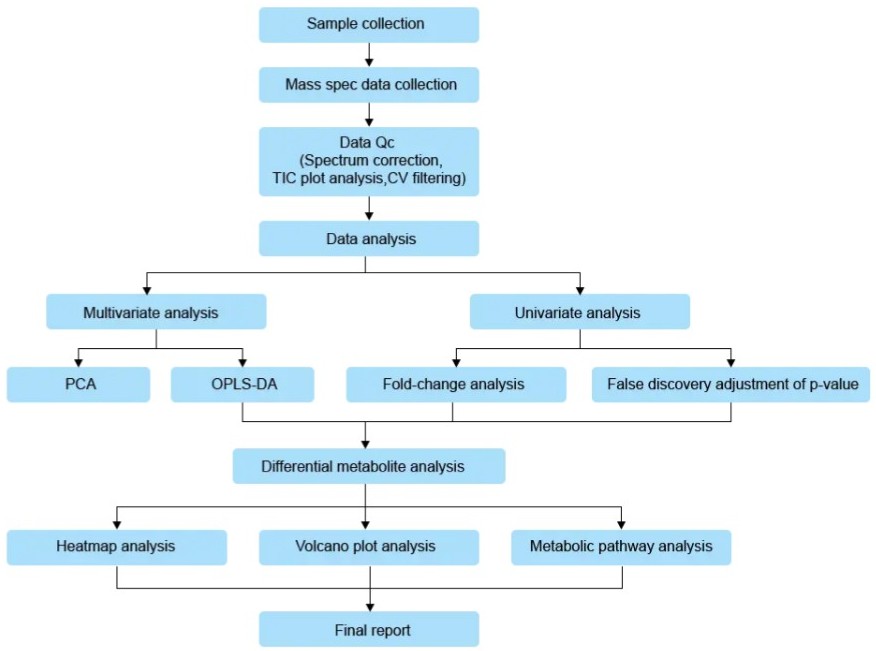
Phytohormone Data Analysis and Deliverables
MetwareBio provides complete deliverables for plant hormone targeted metabolomics, including absolute concentration tables, assay calibration information, quality control summaries, differential phytohormone analysis, KEGG pathway analysis, and a structured project report. Available visualizations may include PCA plots, OPLS-DA plots, volcano plots, heatmaps, Venn diagrams, bar charts, and pathway diagrams, depending on the number of quantified phytohormones, project design, and statistical outcomes. When the detected or differential hormone number is limited, some downstream plots or enrichment analyses may not be applicable. Contact Us for Demo
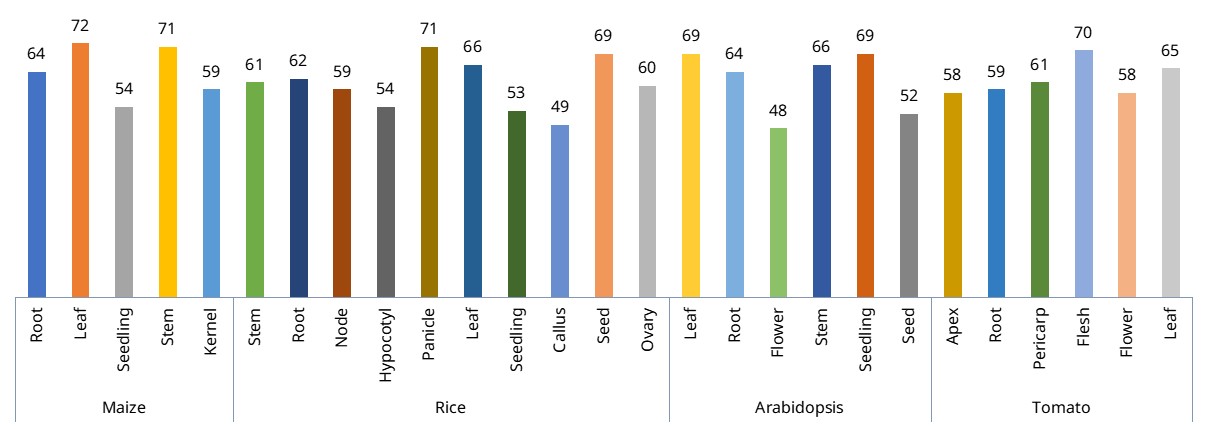
Project Experience in Plant Hormone Profiling
Applications of Targeted Phytohormone Analysis
Plant Growth, Development, and Organogenesis
Plant hormone profiling helps characterize the hormonal regulation of cell division, cell elongation, root architecture, shoot development, organ differentiation, and senescence. Quantitative analysis of auxins, cytokinins, gibberellins, ABA, and other phytohormones can link changes in hormone levels with developmental processes and plant phenotypes.
Stress Responses and Environmental Adaptation
Phytohormones coordinate plant responses to drought, salinity, temperature extremes, flooding, nutrient limitation, pathogens, and herbivores. Quantitative profiling of ABA, jasmonates, salicylic acid-related metabolites, and other hormones supports studies of stress signaling, defense activation, growth–defense trade-offs, environmental adaptation, and stress tolerance.
Seed Germination, Dormancy, and Reproductive Biology
Phytohormone balance is critical for seed development, dormancy, germination, flowering, fertility, and reproductive organ development. Targeted plant hormone analysis enables researchers to track hormonal changes during developmental transitions and investigate the molecular regulation of seed vigor and reproductive performance.
Fruit Ripening, Crop Quality, and Trait Regulation
Plant hormones regulate fruit set, growth, maturation, ripening, coloration, firmness, senescence, and other quality-related traits. Quantitative phytohormone profiling helps connect hormone dynamics with fruit development, postharvest characteristics, treatment responses, and agronomically important crop phenotypes.
Plant Hormone Analysis Case Studies
Case Study 1 | Phytohormone Profiling Supports Tomato Fruit Ripening and Quality Research
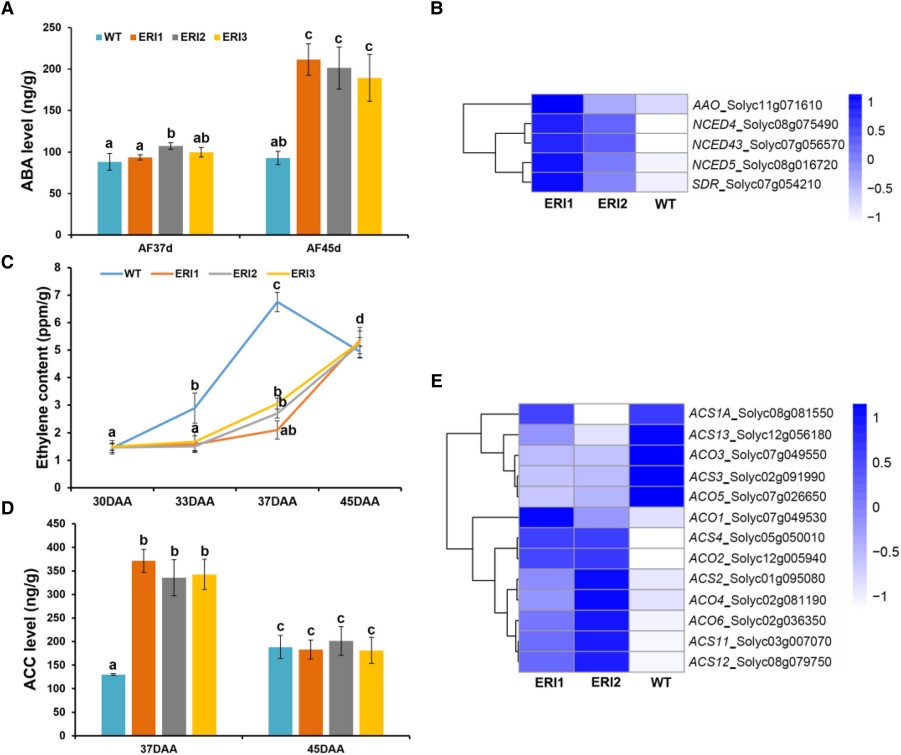
In a Plant Physiology study titled “ETHYLENE-INSENSITIVE 3-LIKE 2 regulates β-carotene and ascorbic acid accumulation in tomatoes during ripening,” researchers investigated how the ethylene-signaling transcription factor SlEIL2 regulates tomato fruit ripening and nutritional quality. Using CRISPR/Cas9 eil2 mutants and SlEIL2 RNAi lines, the study showed that reduced SlEIL2 activity altered fruit coloration and ripening while promoting β-carotene and ascorbic acid accumulation through distinct regulatory pathways. MetwareBio supported the study with targeted ABA and ACC quantification, carotenoids profiling and transcriptome sequencing. Integrated analysis revealed links among SlEIL2-mediated ethylene signaling, carotenoid metabolism, ABA accumulation, and ascorbic acid biosynthesis. This study illustrates how targeted plant hormone analysis combined with complementary omics approaches can support research on hormone signaling, fruit ripening, nutritional quality, and crop traits.
Case Study 2 | Plant Hormone Analysis Reveals ABA–JA Crosstalk in Rice Submergence Tolerance
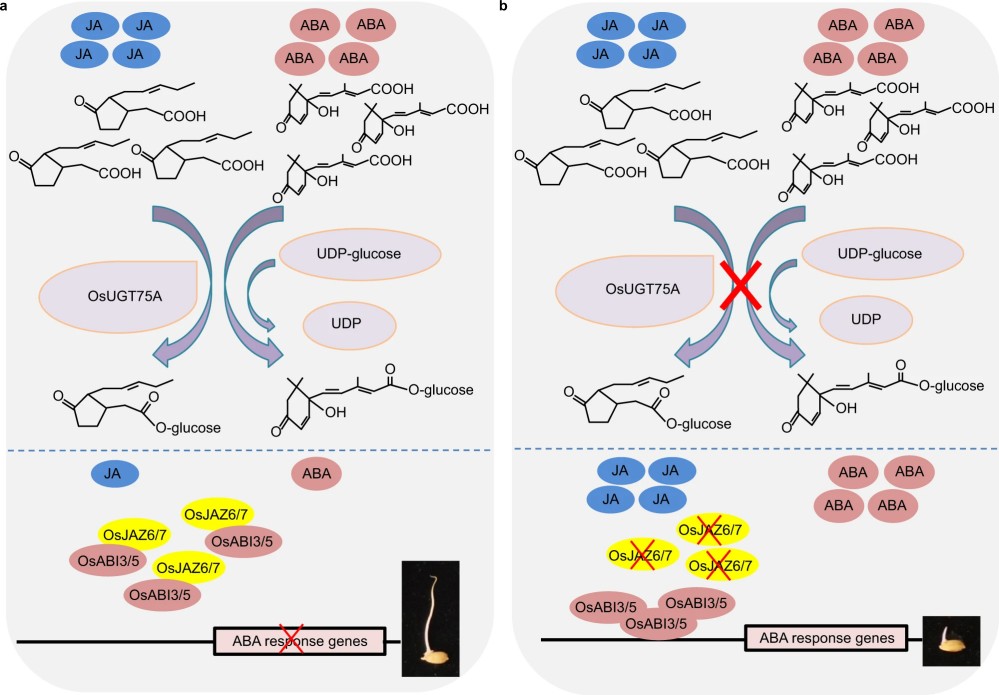
In a Nature Communications study titled “UDP-glucosyltransferase OsUGT75A promotes submergence tolerance during rice seed germination,” researchers investigated the molecular basis of coleoptile elongation under submergence stress. Genetic and functional analyses identified OsUGT75A as a key regulator of rice submergence tolerance, with OsUGT75A knockout reducing coleoptile elongation and overexpression enhancing seedling establishment under submerged conditions. MetwareBio supported the study with targeted phytohormone quantification by LC–MS/MS. Hormone profiling showed that OsUGT75A deficiency increased free ABA, JA, and JA-Ile levels, while subsequent experiments demonstrated that OsUGT75A promotes ABA and JA glycosylation and modulates crosstalk between ABA and JA signaling. The study illustrates how quantitative plant hormone analysis can reveal hormone-regulated mechanisms underlying environmental stress adaptation and support the identification of potential targets for crop stress-tolerance breeding.
Sample Requirements for Phytohormone Analysis
| Sample Type | Standard Sample Input | Biological Replicates | Preparation Notes |
|
Fresh plant tissue (e.g., leaf, root, stem, bud, flower, fruit, seed, callus) |
≥200 mg | ≥3 per group | Collect samples according to the experimental design, keeping tissue type, sampling position, sampling time, and other non-target variables consistent within each comparison group. Freeze immediately in liquid nitrogen, store at −80 °C, and ship on dry ice. Avoid repeated freeze–thaw cycles and prolonged room-temperature exposure. |
Frequently Asked Questions About Plant Hormone Analysis
Q1: What plant hormones can be measured by targeted LC–MS/MS?
MetwareBio’s targeted plant hormone panel quantifies 108 phytohormones and related metabolites across eight major hormone classes: auxins, cytokinins, gibberellins, abscisic acid (ABA), jasmonates, salicylic acid-related metabolites, ethylene precursor, and strigolactones. The panel covers active hormones as well as selected precursors, metabolites, and conjugated forms.
Q2: How are plant hormones quantified by LC–MS/MS?
Plant hormones are quantified using targeted LC–MS/MS with multiple reaction monitoring (MRM). Chemical reference standards, calibration curves, and internal standard correction are used to generate concentration-based quantitative results for individual phytohormones.
Q3: Why use targeted plant hormone analysis instead of untargeted metabolomics?
Targeted plant hormone analysis is preferred when accurate and sensitive quantification of known phytohormones is the primary research goal. Compared with untargeted metabolomics, targeted LC–MS/MS uses hormone-specific analytical conditions and reference standards, providing greater sensitivity and more reliable quantitative measurements for low-abundance plant hormones.
Q4: What plant samples can be used for phytohormone analysis?
Plant hormone analysis can be performed on a wide range of fresh plant tissues, including leaves, roots, stems, flowers, buds, fruits, seeds, seedlings, and other plant organs. Sample collection should follow the experimental design while keeping non-target variables such as tissue position, sampling time, and handling conditions as consistent as possible.
Q5: How should plant samples be collected and stored for hormone analysis?
Plant samples should be rapidly frozen in liquid nitrogen after collection, stored at −80 °C, and shipped on dry ice. Because phytohormone levels can change rapidly after sampling, prolonged room-temperature exposure and repeated freeze–thaw cycles should be avoided.
Q6: Can all 108 phytohormones be detected in every plant sample?
No. The number of phytohormones detected depends on the plant species, tissue type, developmental stage, treatment, and endogenous hormone abundance. Some analytes may be below the analytical detection limit in specific samples, even though they are included in the targeted panel.
Q7: Does the plant hormone panel measure ethylene directly?
The panel measures an ethylene-related precursor rather than ethylene gas directly. Ethylene is a volatile gaseous plant hormone and requires analytical approaches different from conventional LC–MS/MS, whereas its precursor can be quantified using targeted mass spectrometry.
Q8: Can plant hormone profiling be integrated with other omics data?
Yes. Plant hormone profiling can be integrated with transcriptomics, proteomics, metabolomics, and other omics datasets to investigate hormone-regulated biological processes across multiple molecular layers. Such integration can help connect changes in phytohormone abundance with gene expression, protein regulation, metabolic pathways, and plant phenotypes.
References
1. Chen, C., Zhang, M., Zhang, M., et al. (2023). ETHYLENE-INSENSITIVE 3-LIKE 2 regulates β-carotene and ascorbic acid accumulation in tomatoes during ripening. Plant Physiology, 192(3), 2067–2080. https://doi.org/10.1093/plphys/kiad151
2. He, Y., Sun, S., Zhao, J., et al. (2023). UDP-glucosyltransferase OsUGT75A promotes submergence tolerance during rice seed germination. Nature Communications, 14, 2296. https://doi.org/10.1038/s41467-023-38085-5