The pentose phosphate pathway (PPP) is a central route of glucose metabolism that links carbon utilization with NADPH production, redox control, and nucleotide biosynthesis. Its oxidative and non-oxidative branches can redistribute glucose-derived carbon according to cellular demand, making PPP behavior highly context dependent. Understanding this flexibility is important when interpreting metabolic changes in oxidative stress, proliferative states, immune regulation, and disease. This article explains PPP biochemistry and regulation, its integration with glycolysis and central carbon metabolism, and the analytical roles of targeted metabolomics and stable-isotope tracing, helping researchers choose appropriate approaches and interpret PPP-related metabolic changes with clearer mechanistic boundaries.
1. What Is the Pentose Phosphate Pathway?
The pentose phosphate pathway (PPP), historically also called the hexose monophosphate shunt, is a cytosolic glucose-metabolizing pathway that begins from glucose-6-phosphate (G6P), the same metabolite that feeds upper glycolysis. This shared starting point makes the PPP part of the central carbon metabolic network rather than an isolated side route. Its two defining products are reducing power in the form of NADPH and pentose phosphates, particularly ribose-5-phosphate (R5P), which supplies carbon for nucleotide synthesis. The pathway therefore connects glucose availability with redox maintenance, reductive biosynthesis, and the production of building blocks required for cell growth and repair (Stincone et al., 2015; TeSlaa et al., 2023).
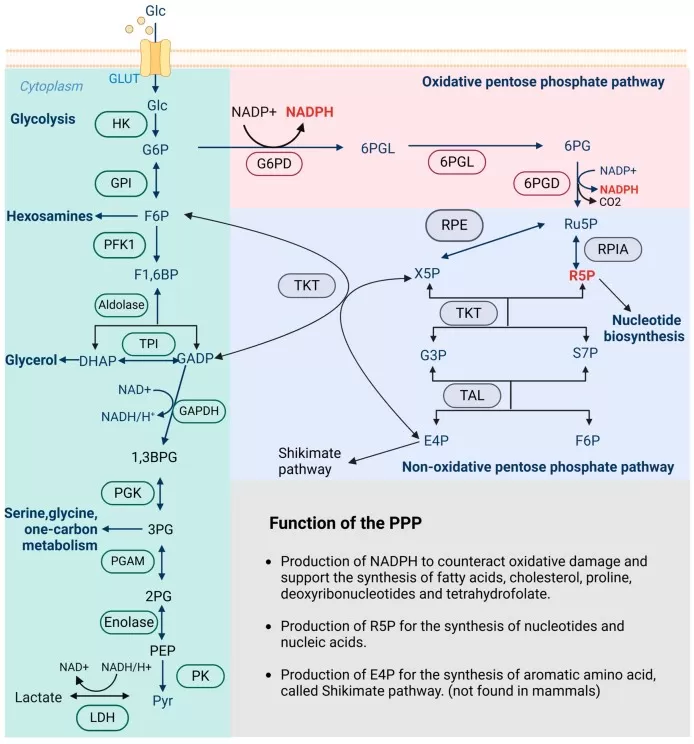
The PPP is organized into an oxidative branch and a non-oxidative branch. The oxidative branch converts G6P to ribulose-5-phosphate (Ru5P) while generating NADPH and releasing carbon dioxide. The non-oxidative branch reversibly rearranges three- to seven-carbon sugar phosphates, allowing pentose phosphates to be produced, consumed, or exchanged with glycolytic intermediates. This architecture gives cells several possible ways to use the pathway. A cell that mainly requires NADPH can oxidize G6P and recycle downstream carbon back toward glycolytic intermediates, whereas a proliferating cell with high ribose demand can draw on non-oxidative reactions to adjust pentose production. PPP function therefore reflects the dynamic allocation of carbon among NADPH production, pentose synthesis, and interconnected glycolytic intermediates in response to cellular metabolic demands (TeSlaa et al., 2023).
2. Oxidative and Non-Oxidative Pentose Phosphate Pathways
2.1 Oxidative PPP: NADPH Production from Glucose-6-Phosphate
The oxidative PPP provides a direct route from G6P to Ru5P while producing two molecules of NADPH per molecule of G6P that passes through the canonical branch. Its first committed reaction is catalyzed by glucose-6-phosphate dehydrogenase (G6PD), which oxidizes G6P while reducing NADP+ to NADPH. The resulting 6-phosphogluconolactone is hydrolyzed to 6-phosphogluconate, and 6-phosphogluconate dehydrogenase then performs a second oxidative step that yields another NADPH, releases CO2, and produces Ru5P. Because carbon is lost as CO2 and both dehydrogenase reactions are strongly biased in the forward direction under physiological conditions, the oxidative branch is effectively irreversible (TeSlaa et al., 2023).
This branch is closely coupled to cellular redox demand. NADPH consumption regenerates NADP+, which can increase G6PD activity and favor oxidative PPP flux, particularly when oxidative stress raises the need for glutathione- and thioredoxin-dependent reduction. The oxidative PPP is not the only cytosolic NADPH source; malic enzyme 1 and cytosolic isocitrate dehydrogenase can also contribute. Their relative contributions depend on cell type and metabolic state, so G6PD expression alone does not define cellular NADPH production (Chen et al., 2019; TeSlaa et al., 2023).
2.2 Non-Oxidative PPP: Reversible Carbon Rearrangement
The non-oxidative PPP converts Ru5P into ribose-5-phosphate and xylulose-5-phosphate and then redistributes their carbon skeletons through a reversible series of transketolase- and transaldolase-catalyzed reactions. Transketolase (TKT) transfers two-carbon units, whereas transaldolase (TALDO1) transfers three-carbon units. Through these reactions, pentose phosphates can generate sedoheptulose-7-phosphate (S7P), erythrose-4-phosphate (E4P), fructose-6-phosphate (F6P), and glyceraldehyde-3-phosphate (G3P). F6P and G3P reconnect directly with glycolysis, giving the pathway a biochemical route for returning pentose-derived carbon to mainstream glucose metabolism (Stincone et al., 2015).
Reversibility is the defining feature of this branch. When nucleotide precursor demand is high relative to NADPH demand, non-oxidative reactions can operate in directions that favor R5P formation from glycolytic intermediates without requiring equivalent oxidative PPP activity. Under other conditions, pentoses generated by the oxidative branch can be converted back to F6P and G3P, allowing their carbon to re-enter glycolysis or be recycled toward G6P. The non-oxidative PPP therefore functions as a carbon-balancing network whose net direction is shaped by metabolite concentrations, thermodynamics, and biosynthetic demand rather than by a single irreversible control point (TeSlaa et al., 2023).
3. Biological Functions of the Pentose Phosphate Pathway
3.1 NADPH Production and Redox Homeostasis
NADPH links PPP activity to both cellular defense and anabolism. In antioxidant systems, NADPH provides reducing equivalents that help regenerate reduced glutathione and maintain thioredoxin in a reduced state. These systems limit the accumulation of reactive oxygen species and protect proteins, lipids, and nucleic acids from oxidative damage. The importance of this function becomes particularly evident in cells exposed to high oxidative pressure, because depletion of reducing capacity can rapidly disrupt membrane integrity, enzyme function, and signaling networks (TeSlaa et al., 2023).
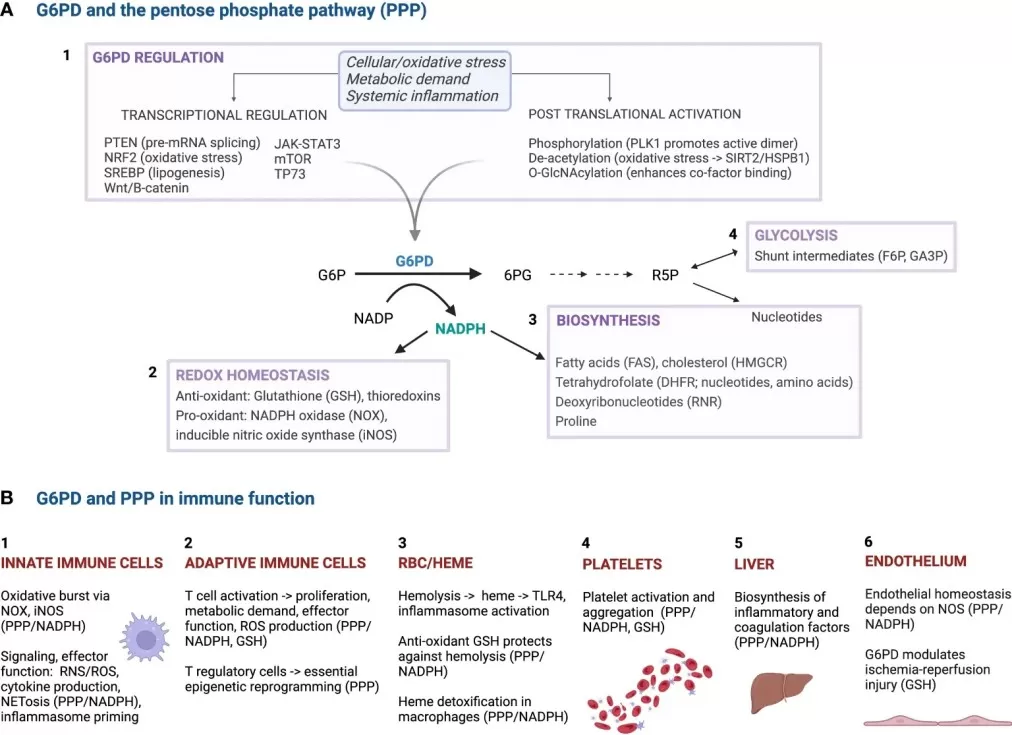
The same reducing currency also supports biosynthesis. NADPH donates electrons to fatty acid and cholesterol synthesis and contributes to reactions involved in folate and deoxyribonucleotide metabolism. Experimental disruption of G6PD in mammalian cells has shown that alternative NADPH-producing reactions can partly compensate for total NADPH supply, yet the oxidative PPP has a distinct role in maintaining the NADPH/NADP+ balance needed for normal folate metabolism (Chen et al., 2019). PPP-derived NADPH should therefore be viewed as part of an integrated redox and biosynthetic system: the relevant biological question is often not simply whether NADPH is present, but how its production and consumption are balanced under a defined metabolic condition.
3.2 Ribose-5-Phosphate and Nucleotide Biosynthesis
Ribose-5-phosphate provides the ribose backbone required for nucleotide production. Ribose-5-phosphate is converted to phosphoribosyl pyrophosphate (PRPP), which supplies activated ribose phosphate for de novo purine and pyrimidine nucleotide synthesis and for several nucleotide salvage reactions. This connection explains why PPP carbon handling becomes important when cells increase DNA replication, RNA production, or nucleotide-dependent cofactor synthesis. Proliferating cells must coordinate nucleotide precursor availability with energy, amino acid, one-carbon, and redox metabolism; R5P supply is one component of that broader biosynthetic program (Stincone et al., 2015; TeSlaa et al., 2023).
Because the non-oxidative branch is reversible, cells can generate pentose phosphates from F6P and G3P when ribose demand exceeds the need for additional NADPH. When NADPH demand is dominant, oxidative PPP carbon can instead be recycled toward glycolytic intermediates. This flexibility prevents a one-to-one relationship between any single PPP intermediate and a particular cellular function.
3.3 Metabolic Flexibility and Carbon Allocation
The PPP can operate in different biochemical modes because its two branches solve different parts of the cell's metabolic problem. If a cell needs both NADPH and ribose in roughly similar proportions, oxidative PPP activity can provide both products directly. If NADPH demand is high but ribose demand is limited, non-oxidative reactions can return pentose carbon to F6P and G3P, allowing carbon recycling and continued NADPH generation. If ribose demand is high relative to NADPH demand, reversible non-oxidative reactions can instead channel glycolytic intermediates toward pentose phosphates (TeSlaa et al., 2023).
This framework helps explain why PPP behavior changes across tissues and experimental conditions. Oxidative stress increases pressure on NADPH regeneration, whereas rapid proliferation increases the need for nucleotides and often for reductive biosynthesis as well. Nutrient limitation, mitochondrial dysfunction, immune activation, and changes in biosynthetic demand can further reshape how much glucose-derived carbon enters, leaves, or cycles through the pathway. The practical implication is that PPP interpretation requires more than measuring one enzyme or one metabolite. A convincing metabolic picture comes from considering the oxidative and non-oxidative branches together with glycolysis, redox cofactors, nucleotide metabolism, and, when flux is the question, isotope-resolved carbon flow.
4. Regulation and Metabolic Crosstalk of the Pentose Phosphate Pathway
4.1 G6PD Regulation of the Oxidative PPP
G6PD is the committed entry enzyme of the oxidative PPP and a major point of acute metabolic control. Its activity responds to the availability of NADP+, which serves as both a reaction substrate and a signal that reducing equivalents have been consumed. When NADPH-dependent reactions increase, NADP+ rises and creates biochemical pressure for greater G6PD activity. NADPH can also restrain G6PD, helping couple pathway entry to the cellular redox state. This substrate-product logic allows the oxidative branch to respond quickly to changing demand without requiring a new transcriptional program (TeSlaa et al., 2023).
Longer-term regulation adds additional layers. G6PD abundance, glucose uptake, G6P availability, and competing use of G6P by glycolysis or glycogen metabolism all influence pathway entry. Increased G6PD expression can therefore indicate greater pathway capacity without proving that more carbon is flowing through the PPP at the time of measurement.
4.2 Regulation of the Non-Oxidative PPP
The non-oxidative branch is regulated less by a single gatekeeper than by the concentrations and ratios of its interconnected sugar-phosphate substrates and products. Because TKT- and TALDO1-mediated reactions are reversible, the direction of net carbon transfer depends on mass action, the availability of pentoses and glycolytic intermediates, and the rate at which downstream pathways consume them. Increased nucleotide synthesis can draw R5P toward PRPP and nucleotide production, while changes in glycolytic demand can alter the availability of F6P and G3P and shift the balance of non-oxidative reactions (Stincone et al., 2015; TeSlaa et al., 2023).
TKT and TALDO1 expression or activity influence branch capacity, but pathway behavior still emerges from network-level demand. Perturbing these enzymes can therefore propagate into glycolysis, redox metabolism, nucleotide synthesis, and mitochondrial metabolism as carbon is redistributed through alternative routes.
4.3 Crosstalk Between the PPP and Glycolysis
The PPP and glycolysis share both an entry point and downstream intermediates. G6P can enter glycolysis or the oxidative PPP, while the non-oxidative PPP can return carbon to glycolysis as F6P and G3P. Carbon allocation between the pathways therefore reflects a balance among ATP production, NADPH demand, nucleotide synthesis, and the need for other biosynthetic precursors. This is why the PPP is most informative when evaluated as part of central carbon metabolism rather than as an isolated pathway.
The connection also complicates interpretation of concentration data. For example, a change in G6P can arise from altered glucose uptake, hexokinase activity, glycolytic consumption, glycogen metabolism, or PPP entry. Likewise, changes in F6P or G3P can reflect several pathways at once. Pathway context, coordinated metabolite patterns, and orthogonal measurements are therefore needed before assigning a concentration change to a specific carbon-routing mechanism (Stincone et al., 2015; TeSlaa et al., 2023).
5. The PPP in Physiology, Disease, and Metabolic Adaptation
5.1 Oxidative Stress and G6PD Deficiency
Red blood cells provide one of the clearest physiological examples of PPP dependence. Mature erythrocytes lack mitochondria and rely heavily on cytosolic glucose metabolism to maintain energy and redox homeostasis. Their limited supply of substrates for alternative NADPH-producing pathways makes the oxidative PPP particularly important for maintaining reducing capacity under continuous oxygen exposure. PPP-derived NADPH therefore plays a central role in supporting glutathione-dependent antioxidant defense (TeSlaa et al., 2023).
In glucose-6-phosphate dehydrogenase deficiency, reduced capacity to generate NADPH can make erythrocytes more vulnerable when oxidant stress increases. Hemoglobin and membrane components become susceptible to oxidative damage, which can lead to episodic hemolysis under triggering conditions. This phenotype illustrates a general principle that extends beyond erythrocytes: the biological consequence of limiting PPP capacity depends strongly on how much alternative NADPH-generating capacity a cell has and how abruptly its redox demand changes.
5.2 Pentose Phosphate Pathway in Cancer Metabolism
Cancer cells often face concurrent demands for nucleotide synthesis, lipid synthesis, redox control, and adaptation to variable nutrient and oxygen availability. The PPP can contribute to each of these requirements by supplying R5P and NADPH, and many tumors show changes in PPP enzymes or glucose-carbon allocation. However, there is no single universal "cancer PPP" state. The relative importance of oxidative and non-oxidative reactions varies with oncogenic signaling, tissue origin, nutrient environment, mitochondrial function, and treatment pressure (Patra and Hay, 2014; TeSlaa et al., 2023).
This context dependence matters when interpreting metabolomics data. Elevated R5P, S7P, or 6-phosphogluconate may be consistent with altered PPP-associated metabolism, but pool sizes do not reveal flux direction. Mechanistic studies therefore benefit from combining concentration profiling with enzyme measurements, isotope tracing, or functional perturbations when the objective is to determine how PPP carbon routing supports a phenotype.
5.3 Pentose Phosphate Pathway in Immune Metabolism
Immune cells reconfigure carbon metabolism as they change activation state and function, and the non-oxidative PPP can participate in this adaptation. A 2022 Nature Metabolism study used regulatory T cell (Treg)-specific deletion of TKT to examine how non-oxidative PPP disruption affects immune homeostasis. In the mouse model, TKT loss impaired Treg suppressive function and was accompanied by reduced glycolysis, increased oxidative stress, excessive fatty acid and amino acid catabolism, impaired mitochondrial fitness, and altered alpha-ketoglutarate-associated epigenetic regulation. The study also reported lower TKT levels in Treg cells from people with autoimmune disorders, linking the experimental mechanism to clinically relevant immune states without implying that the same causal chain has been established in every human autoimmune condition (Liu et al., 2022).
This example shows why pathway analysis benefits from a network perspective. Perturbing a non-oxidative PPP enzyme changed much more than pentose concentrations because carbon redistribution affected glycolysis, redox balance, mitochondrial metabolism, and epigenetic substrate availability. It also illustrates the value of integrating metabolomics with molecular and functional measurements when the biological question extends from pathway state to cell behavior.
6. Methods for Studying the Pentose Phosphate Pathway
6.1 Enzyme, Transcript, and Protein Measurements
PPP regulation can be examined at several molecular levels. Transcriptomics or targeted gene-expression assays can identify changes in genes such as G6PD, PGD, TKT, and TALDO1, while proteomics or immunoblotting can determine whether enzyme abundance changes in parallel. Enzyme activity assays add a functional layer by measuring catalytic capacity under defined assay conditions. These measurements are useful for identifying regulatory mechanisms and for testing whether pathway enzymes are altered by genetic or pharmacological perturbations.
Their interpretive limit is equally important: abundance and activity capacity are not the same as in-cell pathway flux. An enzyme can be highly expressed but substrate limited, inhibited by product accumulation, or embedded in a network where downstream demand is low. Molecular measurements therefore explain potential control points, but they are most informative when linked to metabolite levels or carbon-flow measurements.
6.2 Targeted Metabolomics for PPP Intermediates
Targeted metabolomics measures predefined PPP intermediates and connected metabolites with analytical methods optimized for those compounds. Quantifying 6-phosphogluconate, R5P, Ru5P, xylulose-5-phosphate, S7P, E4P, G6P, F6P, G3P, and relevant redox cofactors can reveal coordinated changes across the oxidative branch, non-oxidative branch, and their interfaces with glycolysis. When validated absolute quantification is used, metabolite abundance can be reported as concentrations in defined units instead of relative signal intensities, providing a quantitative basis for comparing PPP-associated metabolic states across experimental groups.
The value of these measurements comes from patterns rather than isolated intermediates. For example, a coordinated shift in 6-phosphogluconate, pentose phosphates, and glycolytic intermediates can support the conclusion that central carbon metabolism has been remodeled around the PPP. Redox-related measurements can provide additional context for NADPH-associated biology, while nucleotide and TCA-cycle metabolites can show whether the change extends into biosynthetic or mitochondrial metabolism. Because each metabolite pool reflects the balance of formation, consumption, transport, and compartmentation, concentration profiling describes metabolic state; it does not by itself identify the rate or direction of carbon flow.
6.3 Stable-Isotope Tracing for PPP Flux Analysis
Stable-isotope tracing is generally required to resolve how glucose-derived carbon is partitioned between the PPP and competing pathways or to estimate pathway flux. Labeled substrates such as 13C-glucose are introduced into the biological system, and mass spectrometry or NMR is used to follow the resulting isotopologue patterns. Tracer design matters because different carbon-labeling positions provide different information. For PPP studies, position-specific glucose tracers can exploit the loss of carbon 1 as CO2 in the oxidative branch to distinguish oxidative PPP routing from direct glycolytic processing and to estimate relative contributions to downstream metabolites (Reisz and D'Alessandro, 2017; TeSlaa et al., 2023).
Flux analysis requires more than detecting a labeled metabolite. Interpretation depends on tracer enrichment, labeling time, pool size, substrate uptake, carbon recycling, and the model used to connect isotopologues to reaction rates. Relative PPP estimates can also shift when a competing pathway such as glycolysis changes. When absolute rates are important, isotope data are therefore combined with uptake or secretion measurements and appropriate flux modeling (TeSlaa et al., 2023).
The distinction between concentration and flux is central to experimental design. A higher concentration of R5P, S7P, or 6-phosphogluconate can indicate altered PPP-associated metabolism, but it cannot establish that PPP flux increased. Conversely, pathway flux may change while some intermediate concentrations remain buffered. Targeted metabolomics and isotope tracing answer related but different questions, and combining them is often the most informative strategy when both metabolic state and carbon routing matter.
Analytical Approaches for Studying the PPP
| Approach | Primary Measurement | What It Can Resolve | Main Interpretive Limitation |
|---|---|---|---|
| Transcript or protein analysis | PPP enzyme abundance | Regulatory changes and pathway capacity | Expression does not directly measure metabolic activity or flux |
| Enzyme activity assay | Catalytic activity under assay conditions | Enzyme-level functional regulation | Does not reconstruct network-wide carbon routing |
| Targeted metabolomics | Concentrations of PPP and connected metabolites | Metabolic state and coordinated pathway-associated remodeling | Metabolite concentration is not equivalent to pathway flux |
| Stable-isotope tracing | Isotope incorporation and isotopologue distributions | Carbon routing and relative or modeled pathway flux | Requires tracer-specific design, time-course control, and flux interpretation |
7. FAQ: Pentose Phosphate Pathway
Does the pentose phosphate pathway produce ATP?
The PPP does not directly generate net ATP as its defining output. Its oxidative branch primarily generates NADPH and pentose phosphates, while the non-oxidative branch redistributes sugar phosphates. Carbon returned from the PPP to glycolysis as F6P or G3P can subsequently contribute to ATP production through glycolysis, so PPP carbon can indirectly enter ATP-producing metabolism even though ATP production is not the pathway's primary biochemical role.
What is the difference between glycolysis and the pentose phosphate pathway?
Glycolysis primarily converts glucose-derived carbon toward pyruvate while producing ATP and NADH and supplying intermediates for other pathways. The PPP branches from G6P and is specialized for NADPH generation, pentose-phosphate production, and reversible carbon rearrangement. The pathways are tightly connected rather than independent: they compete for G6P at the upper-glucose node, and the non-oxidative PPP exchanges carbon with glycolysis through F6P and G3P.
What is the difference between the oxidative and non-oxidative PPP?
The oxidative PPP is effectively irreversible and converts G6P to Ru5P while generating NADPH and releasing CO2. The non-oxidative PPP is reversible and interconverts pentose phosphates with glycolytic intermediates through TKT- and TALDO1-dependent reactions. This division allows cells to adjust NADPH production and ribose supply according to metabolic demand instead of producing both outputs in a fixed ratio.
Can metabolomics measure pentose phosphate pathway activity?
Targeted metabolomics can quantify PPP intermediates and characterize pathway-associated changes in metabolic state. Those concentration measurements are highly informative for comparing experimental groups, but they do not directly measure reaction rates or carbon flux. When the question is whether more or less glucose-derived carbon is passing through the oxidative or non-oxidative PPP, stable-isotope tracing and appropriate flux analysis are required.
Studying the PPP within Central Carbon Metabolism
The PPP is analytically most informative when its intermediates are interpreted together with the pathways that supply and consume them. G6P allocation links the PPP to glycolysis; F6P and G3P reconnect the non-oxidative branch with glycolysis; NADPH connects carbon metabolism with redox and biosynthetic reactions; and nucleotide, amino acid, and mitochondrial metabolism can all change when PPP carbon handling is perturbed. A pathway-focused experiment therefore benefits from measuring enough of the surrounding network to distinguish a local intermediate change from broader central carbon remodeling.
MetwareBio's Central Carbon Metabolism Targeted Metabolomics service provides absolute quantification of 80 predefined metabolites using targeted LC-MS/MS in MRM mode. The current panel covers glycolysis, pyruvate metabolism, the TCA cycle, the pentose phosphate pathway (PPP), energy-related nucleotides, redox cofactors, and other connected central carbon metabolites. Representative PPP and sugar-phosphate targets include 6-phosphogluconic acid, erythrose-4-phosphate, ribose-5-phosphate, ribulose-5-phosphate, xylulose-5-phosphate, sedoheptulose-7-phosphate, and NADPH. This design is suited to studies that need quantitative comparison of PPP-associated metabolite concentrations across samples or experimental groups.
If you are planning a study involving PPP-associated metabolic changes or broader central carbon metabolism, please contact us to discuss your research needs and the most suitable analytical strategy.
Read More
Continue exploring central carbon metabolism, redox biology, and targeted metabolomics workflows with these MetwareBio articles:
What is Central Carbon Metabolism?
Core overview of glycolysis, the TCA cycle, and the pentose phosphate pathway—how cells route glucose-derived carbon between energy production, redox balance, and biosynthesis.
Central Carbon Metabolism Targeted Metabolomics
MetwareBio's targeted LC-MS/MS panel for absolute quantification of 80 metabolites spanning glycolysis, TCA cycle, and the PPP.
One-Carbon Metabolism in Health and Disease: Pathways, Biomarkers, and LC-MS/MS Analysis
How folate, methionine, and methylation connect to nucleotide synthesis and redox defense, and which targeted LC-MS/MS biomarkers to choose.
LC-MS Made Practical: Principles, Platforms, and a Reproducible Workflow
When to choose QQQ vs HRMS, how to minimize matrix effects, and an end-to-end omics workflow from discovery to validation.
Metabolomics Databases and Pathway Analysis: KEGG, HMDB, and MetaboAnalyst Guide
How to choose and combine KEGG, HMDB, MetaboAnalyst, and MetaboLights without overstating database matches or enrichment results.
One-Carbon Metabolism Targeted Metabolomics (28 key metabolites)
Targeted UPLC-MS/MS panel for 28 folate-, methionine-, and glutathione-pathway intermediates with absolute quantification and standardized QC.
References
- Chen L, Zhang Z, Hoshino A, et al. NADPH production by the oxidative pentose-phosphate pathway supports folate metabolism. Nature Metabolism. 2019;1:404-415. doi: 10.1038/s42255-019-0043-x.
- Liu Q, Zhu F, Liu X, et al. Non-oxidative pentose phosphate pathway controls regulatory T cell function by integrating metabolism and epigenetics. Nature Metabolism. 2022;4(5):559-574. doi: 10.1038/s42255-022-00575-z.
- Patra KC, Hay N. The pentose phosphate pathway and cancer. Trends in Biochemical Sciences. 2014;39(8):347-354. doi: 10.1016/j.tibs.2014.06.005.
- Qiao J, Yu Z, Zhou H, et al. The pentose phosphate pathway: from mechanisms to implications for gastrointestinal cancers. International Journal of Molecular Sciences. 2025;26(2):610. doi: 10.3390/ijms26020610.
- Reisz JA, D'Alessandro A. Measurement of metabolic fluxes using stable isotope tracers in whole animals and human patients. Current Opinion in Clinical Nutrition and Metabolic Care. 2017;20(5):366-374. doi: 10.1097/MCO.0000000000000393.
- Shah SS, Stone EF, Francis RO, Karafin MS. The global role of G6PD in infection and immunity. Frontiers in Immunology. 2024;15:1393213. doi: 10.3389/fimmu.2024.1393213.
- Stincone A, Prigione A, Cramer T, et al. The return of metabolism: biochemistry and physiology of the pentose phosphate pathway. Biological Reviews. 2015;90(3):927-963. doi: 10.1111/brv.12140.
- TeSlaa T, Ralser M, Fan J, Rabinowitz JD. The pentose phosphate pathway in health and disease. Nature Metabolism. 2023;5(8):1275-1289. doi: 10.1038/s42255-023-00863-2.