+1(781)975-1541
support-global@metwarebio.com

Phytohormone Spatial Profiling

Phytohormone Spatial Profiling

High-performance MALDI imaging via Bruker timsTOF fleX.
Flexible resolution ranging from 5 to 100 µm.
Detection of 36 phytohormones across 5 major classes.
Tailored derivatization for trace-level hormone detection.

Overview of Phytohormone Spatial Profiling Technology

Plant hormones (phytohormones) are trace-level signaling molecules that coordinate nearly every stage of plant life. Because hormone biosynthesis, transport, and perception are highly tissue- and cell-context dependent, bulk extraction often masks localized gradients and microenvironment-specific regulation. Spatial metabolomics has rapidly evolved as a powerful approach to visualize molecules directly in situ, preserving anatomical context while revealing heterogeneous distributions. Applying spatial metabolomics to phytohormones makes it possible to map where hormone signals originate, accumulate, and interact across tissues, enabling clearer interpretation of hormone-mediated pathways in development, signaling crosstalk, and stress responses—critical insights for both plant biology and crop improvement.
MetwareBio’s Phytohormone Spatial Profiling delivers an advanced MALDI mass spectrometry imaging (MSI) solution for spatial localization of plant hormones in tissue sections. Built on the Bruker timsTOF fleX platform, our workflow integrates optimized sample preparation and targeted derivatization to enhance phytohormone detectability and analytical specificity. Powered by an extensive in-house database, the service enables sensitive spatial mapping of 36 phytohormones across five major classes: Gibberellins (GAs), Jasmonates (JAs), Auxins, Salicylates (SA-related hormones), and Abscisic Acid (ABA). This phytohormone-focused spatial analysis supports high-confidence studies of hormone signaling, tissue-specific development, and plant stress responses, delivering robust spatial resolution for mechanistic discovery.

The Technical Workflow of MALDI-based Phytohormone Spatial Profiling

Why Choose MetwareBio for Phytohormone Spatial Profiling?

Extensive phytohormone coverage
Enables spatial mapping of 36 phytohormones across five major classes, including Gibberellins (GAs), Jasmonates (JAs), Auxins, Salicylates (SA-related hormones), and Abscisic Acid (ABA), supporting comprehensive investigation of plant hormone regulation.
Enhanced detection specificity
Optimized sample preparation combined with tailored derivatization strategies improves the detectability and analytical specificity of trace-level phytohormones in tissue sections, overcoming the challenges posed by low abundance and complex plant matrices.
High-resolution spatial analysis
Powered by the Bruker timsTOF fleX MALDI-MSI platform, the service enables sensitive in situ visualization of phytohormone distributions while preserving tissue context, making it ideal for studying localized signaling and tissue-specific metabolism.
Strong analytical confidence
Supported by an extensive in-house phytohormone database and a standardized imaging workflow, the platform delivers robust, reproducible, and biologically meaningful spatial profiling results for plant development and stress response research.

Phytohormone Coverage for Spatial Metabolomics Analysis

MetwareBio’s Phytohormone Spatial Profiling service enables the spatial visualization of 36 phytohormones across five major hormone classes, providing broad coverage of key signaling molecules involved in plant growth, development, and stress responses. The detectable panel includes 13 auxins, 11 gibberellins (GAs), 6 jasmonates (JAs), 5 salicylates, and 1 abscisic acid (ABA), representing central components of plant hormone regulatory networks. This metabolite coverage supports spatial metabolomics analysis of phytohormone distribution patterns within plant tissues, allowing researchers to investigate hormone gradients, tissue-specific accumulation, and hormone crosstalk in situ.
Metabolite Database of Phytohormone Spatial Profiling Service
Class Number Compound
Auxins 13 IAA-Glu, OxIAA, IAA-Asp, IAA-Leu, IAA-Val, IAA-Trp, ILA, IA, IAA-Ala, IAA-Phe, ICA, IAA, IBA
Gibberellins (GAs) 11 GA15, GA19, GA53, GA7, GA9, GA8, GA5, GA6, GA29, GA34, GA12-ald
Jasmonates (JAs) 6 OPC-4, OPC-6, H2JA, JA, JA-ILE, 12-OH-JA
Salicylates 5 SA, SAG, Phe, t-CA, 2-Coumarate
Abscisic Acid 1 ABA

Note: For cytokinin analysis, please consider our MALDI untargeted spatial metabolomics service.

Plant Hormone Spatial Metabolomics Analysis Workflow
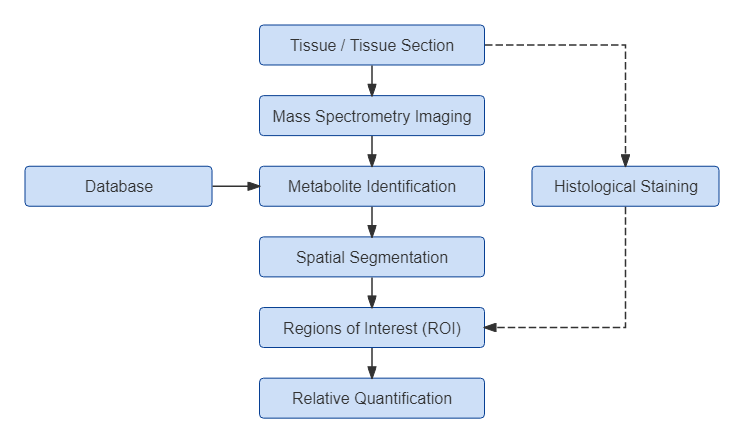
MetwareBio’s Phytohormone Spatial Profiling workflow combines sample collection, tissue sectioning, matrix coating, and mass spectrometry imaging to visualize phytohormone distributions directly in plant tissues. Supported by database-assisted metabolite identification, spatial segmentation, ROI analysis, and relative quantification, this workflow enables reliable spatial metabolomics analysis of plant hormones for research on tissue-specific regulation, hormone signaling, and plant stress responses.
Phytohormone Spatial Profiling Analysis Workflow

Applications of Plant Hormone Spatial Profiling

Plant Development & Hormone-Regulated Patterning

Spatial profiling of phytohormones provides direct insight into how localized hormone gradients shape plant growth, organ initiation, vascular differentiation, and reproductive development. By visualizing the in situ distribution of auxins, gibberellins, jasmonates, salicylates, and abscisic acid, researchers can dissect tissue-specific signaling networks underlying root architecture, leaf formation, meristem activity, seed development, and fruit maturation. This spatially resolved approach is particularly valuable for decoding hormone crosstalk in developmental biology and functional plant research.

Plant Stress Biology & Adaptive Response Mechanisms

Phytohormones are central regulators of plant responses to drought, salinity, temperature extremes, wounding, and pathogen challenge. Spatial metabolomics enables precise mapping of hormone accumulation and redistribution within stressed tissues, revealing localized defense activation, stress signaling hubs, and adaptive metabolic reprogramming. This approach supports mechanistic studies of ABA-mediated abiotic stress tolerance, JA- and SA-associated defense pathways, and multi-hormone coordination in resilience phenotypes, making it highly relevant for plant stress physiology and crop adaptation research.

Plant–Pathogen & Plant–Environment Interactions

The spatial behavior of phytohormones is critical for understanding how plants perceive and respond to microbes and environmental cues. Spatial phytohormone analysis can uncover where immune-related hormones are produced, transported, and accumulated during infection or environmental perturbation, providing a refined view of defense signaling and local–systemic communication. These data support research on host–pathogen interactions, induced resistance, wound signaling, and rhizosphere-associated responses, helping identify molecular mechanisms that govern plant health and environmental adaptation.

Crop Improvement, Functional Genomics & Agricultural Research

Phytohormone spatial profiling offers a powerful tool for linking molecular phenotypes to agronomic traits in crops. By comparing hormone localization patterns across genotypes, treatments, developmental stages, or engineered lines, researchers can identify regulatory hotspots associated with growth vigor, stress tolerance, yield formation, and tissue-specific traits. The technology is well suited for functional genomics, mutant characterization, trait validation, and breeding research, providing spatially resolved molecular evidence to accelerate crop improvement and precision plant science.

Validated Expertise in Phytohormone Spatial Metabolomics

MetwareBio has extensive experience in plant spatial metabolomics, with a mature MALDI-MSI workflow and professional technical operations. Our Phytohormone Spatial Profiling service has been validated in multiple plant species and diverse tissue types, including fruits, leaves, roots, seeds, and vascular tissues. This broad hands-on experience enables us to deliver standardized processing and reliable spatial metabolomics data for plant biology and crop research.

Number of Metabolites Mapped Across Various Plant Tissues by MALDI-based Phytohormone Spatial Profiling

Sample Requirements & Submission Guidelines for Phytohormone MSI

1) For Fresh-Frozen Tissue Blocks:
  • Embedding Medium: CMC is recommended for optimal tissue support during sectioning.
  • Tissue Cross-section Size: 1.5 × 1.5 mm (min) – 50 × 30 mm (max)
  • Tissue Height: 2 mm (min) – 25 mm (max)
  • Storage & Shipment: Store samples in a frozen tissue storage box and ship on dry ice to maintain sample integrity.
2) Tissue Sections
  • Slide Type: ITO-coated slides are required for MALDI-MSI analysis.
  • Maximum Scanning Area: 65 × 40 mm
  • Section Thickness: 8–50 µm
  • Storage & Shipment: Store sections in a slide box and ship on dry ice.

FAQs about Phytohormone Spatial Profiling

1. What plant samples are suitable for phytohormone spatial profiling?

Our Phytohormone Spatial Profiling service is applicable to a wide range of plant tissues, including fruits, leaves, roots, seeds, stems, and flowers. Fresh-frozen tissue blocks or tissue sections are recommended as sample submission formats to best preserve metabolite integrity and spatial distribution for MALDI-MSI analysis.

2. How should plant samples be prepared for MALDI-MSI analysis?

For optimal spatial metabolomics results, plant samples should be fresh-frozen as quickly as possible after collection to preserve native metabolite distributions. Tissue blocks are typically embedded in CMC, sectioned at an appropriate thickness, mounted on ITO-coated slides, and stored or shipped on dry ice.

3. What platform is used for phytohormone spatial profiling?

This service is performed on the Bruker timsTOF fleX platform using MALDI-based mass spectrometry imaging (MALDI-MSI). Combined with optimized sample preparation and derivatization strategies, the platform enables sensitive spatial visualization of trace-level phytohormones in plant tissues.

4. What phytohormones can be detected with this service?

Our workflow supports the spatial detection of 36 phytohormones across five major classes: Auxins, Gibberellins (GAs), Jasmonates (JAs), Salicylates, and Abscisic Acid (ABA). This coverage supports research on plant hormone signaling, tissue-specific regulation, and stress responses.

5. How do I choose the optimal spatial resolution for spatial metabolomics analysis?

The optimal spatial resolution depends on your research goal, tissue structure, and target distribution pattern. Higher resolution is more suitable for small or heterogeneous tissue regions, while moderate resolution is often sufficient for broader tissue-level profiling. Our team can recommend an appropriate resolution based on your sample type and project objectives.

Next-Generation Omics Solutions:
Proteomics & Metabolomics

Have a project in mind? Tell us about your research, and our team will design a customized proteomics or metabolomics plan to support your goals.
Ready to get started? Submit your inquiry or contact us at support-global@metwarebio.com.
Name can't be empty
Email error!
Message can't be empty
CONTACT FOR DEMO
Name error
E-mail error
Description error
The files will be available for download after the form is submitted!
+1(781)975-1541
LET'S STAY IN TOUCH
submit
Copyright © 2025 Metware Biotechnology Inc. All Rights Reserved.
support-global@metwarebio.com +1(781)975-1541
8A Henshaw Street, Woburn, MA 01801
Contact Us Now
Name can't be empty
Email error!
Message can't be empty