

Neurotransmitter Spatial Profiling
Neurotransmitter Spatial Profiling
Overview of Neurotransmitter Spatial Profiling Technology
The Technical Workflow of MALDI-based Phytohormone Spatial Profiling
Why Choose MetwareBio for Neurotransmitter Spatial Profiling?
Neurotransmitter Coverage in Spatial Profiling Analysis
| Neurotransmitter | Formula | CAS | KEGG ID | PubChem CID |
| Glycine | C2H5NO2 | 56-40-6 | C00037 | 750 |
| Sarcosine | C3H7NO2 | 107-97-1 | C00213 | 1088 |
| Gamma-Aminobutyric Acid | C4H9NO2 | 56-12-2 | C00334 | 119 |
| Serine | C3H7NO3 | 56-45-1 | C00065 | 5951 |
| Histamine | C5H9N3 | 51-45-6 | C00388 | 774 |
| Valine | C5H11NO2 | 72-18-4 | C00183 | 6287 |
| Succinic Acid | C4H6O4 | 110-15-6 | C00042 | 1110 |
| Threonine | C4H9NO3 | 72-19-5 | C00188 | 6288 |
| Taurine | C2H7NO3S | 107-35-7 | C00245 | 1123 |
| Agmatine | C5H14N4 | 2482-00-0 | C00179 | 2794990 |
| Leucine | C6H13NO2 | 61-90-5 | C00123 | 6106 |
| Tyramine | C8H11NO | 51-67-2 | C00483 | 5610 |
| Glutamine | C5H10N2O3 | 56-85-9 | C00064 | 5961 |
| Lysine | C6H14N2O2 | 56-87-1 | C00047 | 5962 |
| Glutamic Acid | C5H9NO4 | 56-86-0 | C00025 | 33032 |
| Methionine | C5H11NO2S | 63-68-3 | C00073 | 6137 |
| 3-Hydroxyanthranilic Acid | C7H7NO3 | 548-93-6 | C00632 | 86 |
| Dopamine | C8H11NO2 | 51-61-6 | C03758 | 681 |
| Phenylalanine | C9H11NO2 | 63-91-2 | C00079 | 6140 |
| 3-methoxytyramine (3-MT) | C9H13NO2 | 554-52-9 | C05587 | 1669 |
| Norepinephrine | C8H11NO3 | 51-41-2 | C00547 | 439260 |
| Arginine | C6H14N4O2 | 74-79-3 | C00062 | 6322 |
| 5-HT | C10H12N2O | 50-67-9 | C00780 | 5202 |
| Homovanillic Acid (HVA) | C9H10O4 | 306-08-1 | C05582 | 1738 |
| Epinephrine | C9H13NO3 | 51-43-4 | C00788 | 5816 |
| L-dopa | C9H11NO4 | 59-92-7 | C00355 | 6047 |
| Tryptophan | C11H12N2O2 | 73-22-3 | D00020 | 6305 |
| Xanthurenic Acid | C10H7NO4 | 59-00-7 | C02470 | 5699 |
| 5-Methoxyindole-3-Acetic Acid | C11H11NO3 | 3471-31-6 | C05660 | 18986 |
| Kynurenine | C10H12N2O3 | 2922-83-0 | C00328 | 161166 |
| N-Acetylserotonin | C12H14N2O2 | 1210-83-9 | C00978 | 903 |
| Metanephrine hydrochloride | C10H16ClNO3 | 881-95-8 | C05588 | 102502 |
| Glutathione | C10H17N3O6S | 70-18-8 | C02471 | 124886 |
| Levothyroxine | C15H11I4NO4 | 51-48-9 | C01829 | 5819 |
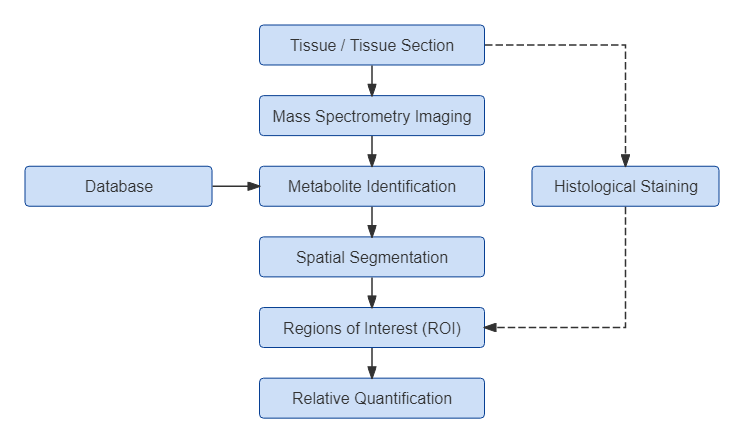
Neurotransmitter Spatial Metabolomics Analysis Workflow
Applications of Neurotransmitter Imaging in Neuroscience Research
Spatial profiling of neurotransmitters provides direct insight into how localized neurochemical signals shape neural circuit activity, synaptic transmission, and region-specific brain function. By visualizing the in situ distribution of amino acids, monoamines, catecholamines, and related metabolites, researchers can dissect neurochemical organization across distinct brain regions and tissue microenvironments. This spatially resolved approach is particularly valuable for understanding neurotransmitter dynamics, neural communication, and functional brain architecture.
Neurotransmitter imbalance is closely associated with the onset and progression of many neurological disorders, including Parkinson’s disease, Alzheimer’s disease, depression, and other neurodegenerative conditions. Spatial metabolomics enables precise mapping of neurotransmitter depletion, accumulation, and metabolic alteration within affected tissues, revealing localized neurochemical dysregulation and disease-associated molecular signatures. This approach supports mechanistic studies of neuronal vulnerability, pathological progression, and neurochemical changes in diseased brain regions.
The spatial behavior of neurotransmitters is critical for understanding communication within complex brain microenvironments. Neurotransmitter spatial profiling can reveal where signaling molecules are enriched, released, or metabolized, providing a refined view of neuron–glia interactions, synaptic niches, and localized molecular crosstalk. These data support research on microenvironment-dependent signaling, regional metabolic heterogeneity, and the molecular basis of brain function in both normal and pathological states.
Neurotransmitter spatial profiling offers a powerful tool for evaluating how drugs, interventions, or disease models alter neurochemical distributions within tissues. By comparing neurotransmitter localization patterns across treatment groups, brain regions, or experimental conditions, researchers can identify pharmacologically responsive areas and neurochemical changes associated with therapeutic effects or adverse responses. This technology is well suited for translational neuroscience, biomarker research, and preclinical evaluation of neuroactive compounds.
Sample Requirements & Submission Guidelines for Neurotransmitter MSI
- Embedding Medium: CMC is recommended for optimal tissue support during sectioning.
- Tissue Cross-section Size: 1.5 × 1.5 mm (min) – 50 × 30 mm (max)
- Tissue Height: 2 mm (min) – 25 mm (max)
- Storage & Shipment: Store samples in a frozen tissue storage box and ship on dry ice to maintain sample integrity.
- Slide Type: ITO-coated slides are required for MALDI-MSI analysis.
- Maximum Scanning Area: 65 × 40 mm
- Section Thickness: 8–50 µm
- Storage & Shipment: Store sections in a slide box and ship on dry ice.
FAQ about MALDI-MSI Neurotransmitter Imaging
Neurotransmitter Spatial Profiling is a spatial metabolomics approach for visualizing neurotransmitter-related compounds directly within tissue sections. By combining MALDI-MSI with optimized sample preparation and derivatization, this method enables in situ mapping of neurochemical signals while preserving anatomical context.
Unlike conventional bulk analysis, spatial metabolomics preserves tissue architecture and reveals where neurotransmitters are distributed within neural tissues. This makes it possible to study region-specific neurochemical patterns, localized signaling, and disease-associated molecular changes.
This service is compatible with a wide range of nervous system tissues, including brain, spinal cord, and other neural tissues. Fresh-frozen tissue blocks or tissue sections are recommended to preserve metabolite integrity and spatial distribution for MALDI-MSI analysis.
The Neurotransmitter Spatial Profiling workflow supports the spatial detection of 34 key neurotransmitter-related compounds, covering major classes such as amino acids, monoamines, catecholamines, and related metabolites. This coverage supports research on neural signaling, brain metabolism, and neurochemical regulation.
This service is performed on the Bruker timsTOF fleX platform using MALDI-based mass spectrometry imaging (MALDI-MSI). Combined with optimized sample preparation and derivatization strategies, the platform enables sensitive spatial visualization of trace-level neurotransmitters in situ.
This service generates spatial distribution maps, metabolite identification results, ROI-based analysis, and relative quantification data for neurotransmitter-related compounds. These outputs support both biological interpretation and comparative neurochemical analysis.
Next-Generation Omics Solutions:
Proteomics & Metabolomics
Ready to get started? Submit your inquiry or contact us at support-global@metwarebio.com.
